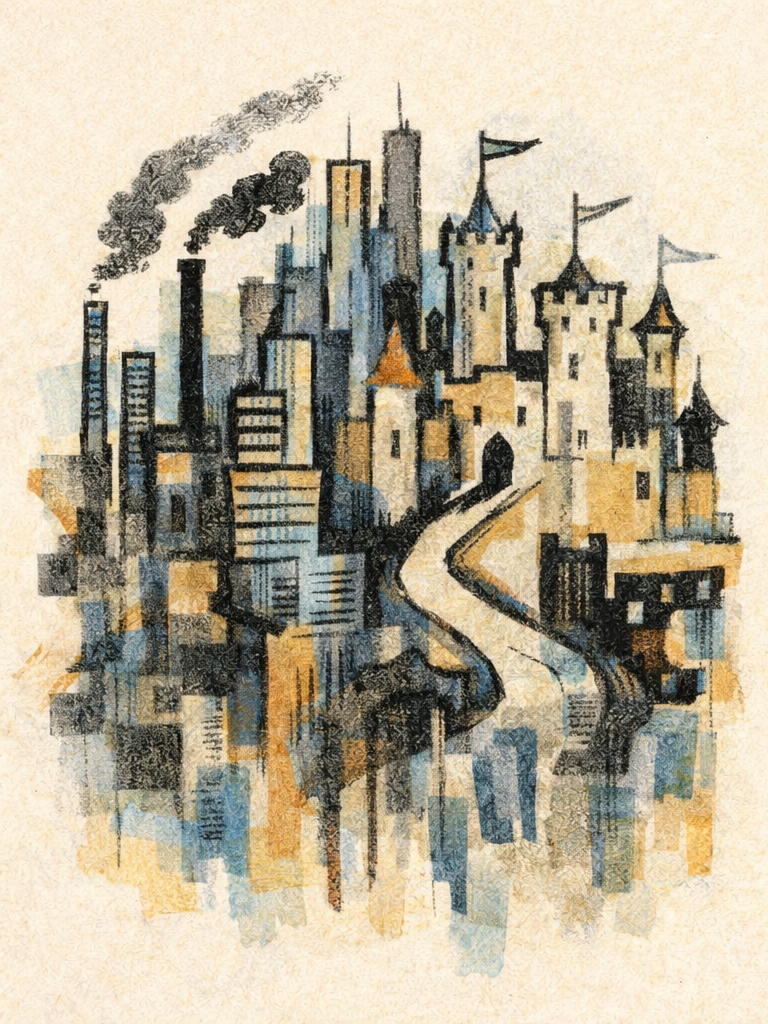
Feudal Echoes, Modern Gatekeepers, and the Strange Comfort of Castles
Western history is usually told as a clean escape story. The Middle Ages were hierarchy, destiny, and inherited rank; modernity is democracy, contracts, and upward mobility. Revolutions broke the spell. Birth lost its legal magic. In theory, the ladder replaced the lineage.
But if you stop treating law as the whole of society and start watching where leverage actually sits, an older silhouette appears. Not feudalism in the strict historical sense—no serfdom statutes, no titled nobility with formal exemptions—but a familiar geometry of dependence: a minority controlling gateways, and a majority negotiating access to life through rent, wages, fees, and permission.
Modern capitalism didn’t resurrect the manor house. It refurbished it.
A Renovated Aristocracy
In medieval Europe, land wasn’t just property; it was power, security, and survival. Whoever owned the land controlled the terms on which everyone else lived. Today, the “land” isn’t only farmland. It’s housing markets, capital markets, patents, platforms, and the infrastructure of attention. The basic move is the same: control the scarce thing, then charge for access.
That’s why the idea of “patrimonial capitalism” resonates. When existing wealth compounds faster than wages and faster than the economy’s general growth, inheritance stops being a background detail and becomes a main engine. You don’t need a crown if you can hand down an asset base that grows while you sleep. You don’t need a title if your children begin adulthood already owning the “ground” on which others must bargain.
There’s a social psychology to this that numbers alone don’t capture. Feudal elites were physically distant from common life. That distance wasn’t just taste; it was architecture. You can still see a modern version of that distance in the way some ultra-wealthy people live: not merely “in good neighborhoods,” but behind layers of separation—properties set so far back from public roads they are effectively invisible, private drives and gates that turn geography into privilege. A medieval castle was built to withstand siege. A modern fortress is built to eliminate contact. Different motives, different technologies, same outcome: insulation as status.
Democracy Outside, Monarchy Inside
If you want to understand why “feudal” keeps reappearing as a metaphor, look at where most adults spend most of their waking lives: workplaces.
Modern states grant political rights to citizens; modern firms rarely grant governance rights to workers. Most organizations are command hierarchies with limited internal democracy. You can vote in national elections and still spend your week inside a structure where speech can be disciplined, privacy can be thin, and livelihood depends on managerial discretion. This is what people mean when they describe workplaces as a form of private government: rule without representation, softened by the fact that, in theory, you can leave.
That “in theory” matters. Exit is the modern substitute for voice, and it’s unevenly distributed. If switching jobs means losing health insurance, losing housing stability, or falling into debt, your freedom of exit starts to look less like liberty and more like a bargaining chip you can’t afford to use. The system doesn’t need chains if it can create conditions where the cost of leaving is punishing.
The gig economy intensifies the resemblance because it blurs who owns what. Many platform workers provide the tool, take the risk, and supply the labor, yet must still pay a cut to access the market. It’s not serfdom, but it can feel like working “your” plot on someone else’s terms.
Platforms as Digital Manors
Feudalism isn’t only about bosses. It’s about gatekeeping: owning the mill, the bridge, the road, the market day—then taking a share from every interaction that passes through.
That’s why the “techno-feudalism” thesis is tempting. Many big tech firms are not simply selling products; they are owning the marketplace itself. If the platform is the road and the bazaar, then everyone else becomes a tenant of the infrastructure. Merchants pay for visibility. Creators depend on algorithmic favor. Users generate the raw material of attention and data that platforms monetize at scale.
Still, it’s important not to let a metaphor harden into a verdict. The digital economy also contains intensely capitalist dynamics: competition, innovation, price wars, disruption, and rapid turnover. The “feudal” element is not that nothing changes; it’s that the power to set terms increasingly concentrates in whoever owns the chokepoints.
Why We Keep Dreaming of Thrones
If feudal logic survives only in economics, the metaphor would remain technical. But it also shows up in what people fantasize about.
The mass appeal of medieval-flavored worlds—Game of Thrones, Vikings, World of Warcraft—doesn’t “prove” feudal structures have returned. That claim would be sloppy. Popularity can come from great storytelling, production budgets, marketing, and trend cycles.
What the popularity does suggest, more cautiously, is that feudal imagery still speaks to something in the social subconscious: the desire for visible hierarchy, clear allegiance, symbolic order, and belonging. Modern life offers freedom, but it also offers endless ambiguity. In a world where power often hides behind legal entities, algorithms, and jargon, fantasy offers an almost perverse relief: rulers are identifiable, stakes are legible, loyalty has a banner, and meaning is carved into rituals rather than negotiated in emails.
Even when these stories depict feudal cruelty, they also aestheticize feudal structure. The audience may not want lords; it may want clarity. The difference matters. Nostalgia for the aesthetic of order is not the same thing as a political desire for subjugation. But it’s not unrelated, either.
Where the Analogy Breaks
A serious version of this argument has to admit the discontinuities, or it becomes sermon instead of analysis.
Feudalism fused economic control with formal political and legal hierarchy. Modern states, at least in principle, separate these domains. Modern citizens can sue employers, organize politically, move across regions, and change professions—possibilities that were radically constrained in medieval systems. Markets and technologies also reshape elites faster than bloodlines once did. A tech fortune can rise in one generation; a feudal title typically didn’t.
Most importantly, modern legal equality is not just a slogan. It’s imperfect, uneven, and often distorted by money and access to top-tier representation, but it is real enough that highly privileged figures can be prosecuted and imprisoned. Martha Stewart’s prison sentence and Bernie Madoff’s sentence are blunt reminders that modern systems can punish wealth and status in ways classic feudal orders rarely did. That doesn’t mean justice is equally distributed. It means the legal structure is different in kind.
Material living standards also complicate the story. The average worker in a developed country lives with comforts medieval nobles couldn’t imagine. That can make dependence feel less like domination, or simply harder to notice. Better living does not automatically mean fairer power—but it does mean “feudal” can’t be used as a lazy synonym for “bad.”
How to Test the Thesis Without Turning It Into Rhetoric
If the “feudal echoes” claim is more than a vibe, it should leave fingerprints.
You would expect to see wealth concentrating not only through high incomes but through asset ownership, with inheritances and family transfers playing an increasing role in who joins the top. You would expect housing costs and rent burdens to rise relative to wages in places where opportunity concentrates, turning location itself into a gate. You would expect weaker bargaining power for labor to show up as stagnating wage shares, falling union density, and more precarious work arrangements. You would expect gatekeeper firms—especially platforms—to capture a growing portion of transactions as tolls, fees, or “take rates,” and you would expect markets to become more concentrated in sectors where network effects dominate.
None of these indicators, on their own, “proves feudalism.” But together they can support a narrower, defensible conclusion: modern societies can be legally egalitarian while functionally stratified in ways that rhyme with older regimes of dependency.
A More Honest Ending
The strongest version of this argument does not say, “We are back in the Middle Ages.” It says: the abolition of feudal law did not abolish the logic of gatekeeping. It changed its costume.
We replaced the divine right of kings with the quiet sanctity of capital and the normality of ownership. Extraction moved from tithes to rent, from the lord’s mill to the platform’s toll, from explicit rank to compounding advantage. Entry into the elite is more open than it used to be, and legal equality is vastly expanded—but the underlying shape of dependence remains stubbornly recognizable.
If that feels unsettling, it may be because the manor is hardest to question when it no longer looks like a castle. Sometimes it looks like a portfolio. Sometimes it looks like a platform. Sometimes it looks like a long driveway you’ll never see from the road.